
Steel Frame House or Brick House: Which Is the Better Choice?
If you want a faster, lighter, and more precise construction, a steel frame is an excellent choice. If you prefer a traditional construction method, a brick house remains a well-established option. Below, we analyze the main differences between the two construction systems.
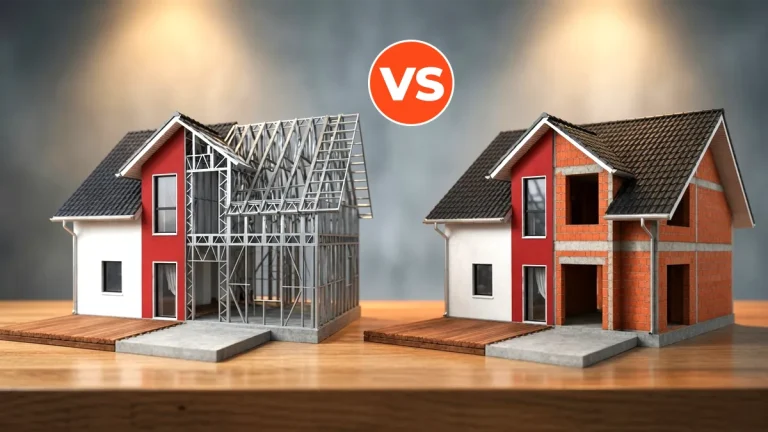
| Characteristic | Steel Frame | Brick | Advantage |
|---|---|---|---|
| Construction speed | Fast construction, prefabricated components | Slower construction | 🏆 Steel Frame |
| Construction site organization | Clean and organized construction site, minimal waste | Busier construction site, more materials and waste | 🏆 Steel Frame |
| Wall flatness | Straight walls, easier finishing | May require corrections | 🏆 Steel Frame |
| Structural strength | Excellent strength-to-weight ratio | Good structural strength | 🏆 Steel Frame |
| Earthquake resistance | Very good due to its low weight | Good, when combined with reinforced concrete columns and ring beams | 🏆 Steel Frame |
| Durability | Long service life | Long service life | 🤝 Equal |
| Energy efficiency | Depends on the insulation system | Depends on the insulation system | 🤝 Equal |
| Environmental impact | Recyclable steel, minimal waste | Higher resource consumption | 🏆 Steel Frame |
| Design flexibility | Large spans and flexible layouts | Requires additional structural elements | 🏆 Steel Frame |
Construction speed
One of the biggest advantages of a steel frame house is the speed of construction. The components are manufactured with precision in the factory and delivered ready for assembly, significantly reducing on-site construction time and minimizing delays caused by weather conditions or variations in building materials.
In contrast, brick construction requires more labor and a longer construction period due to the masonry process and the time needed for materials to dry and cure.
Advantage: Steel Frame
Construction site organization
The installation of a lightweight steel frame takes place on a much cleaner and better organized construction site. The components are manufactured to exact dimensions in the factory and delivered ready for assembly, significantly reducing waste, material losses, and on-site storage requirements.
In the case of brick construction, the building process involves transporting and storing a large number of materials, preparing mortar, using formwork and reinforcement for reinforced concrete elements, and generating a greater amount of waste and leftover materials throughout the construction process.
Advantage: Steel Frame
Wall flatness
Steel frame components are manufactured with millimeter precision, allowing for straight and uniform walls. This simplifies the installation of drywall panels and reduces the need for corrections during the finishing stage.
In masonry construction, wall flatness deviations may occur, requiring additional plastering or corrective work.
Advantage: Steel Frame
Structural strength
Steel has an excellent strength-to-weight ratio, making it possible to build structures that are both strong and lightweight. Unlike other materials, steel maintains its dimensional stability over time and is not affected by shrinkage or deformation caused by changes in humidity. In addition, the reduced weight of the structure can contribute to more economical foundation design.
Advantage: Steel Frame
Earthquake resistance
Thanks to their low weight and the high strength of steel, steel frame structures develop lower seismic forces than heavy masonry buildings. When designed in accordance with applicable building codes, they provide excellent performance in earthquake-prone areas.
Advantage: Steel Frame
Durability
Both construction systems can have a very long service life when they are properly designed and built. Galvanized steel structures are protected against corrosion, while brick buildings have proven their durability over time. In both cases, the quality of the materials and the workmanship are essential factors.
Advantage: Both systems
Energy efficiency
The energy performance of a house depends primarily on the insulation system, windows and doors, roof, and quality of workmanship, not only on the structural material. A properly insulated steel frame house can achieve an excellent level of energy efficiency and low heating and cooling costs.
Advantage: Both systems
Environmental impact
Steel structures have a lower environmental impact thanks to the efficient use of materials and the controlled manufacturing process. Steel is one of the most recycled materials in the world and can be reused without losing its properties. In addition, manufacturing components to exact dimensions reduces the amount of waste generated on the construction site, while the lower weight of the structure can help reduce the amount of materials required for the foundation and improve transport efficiency.
Brick construction generally requires a greater consumption of raw materials and generates larger amounts of waste during the construction process.
Advantage: Steel Frame
Design flexibility
Steel structures allow for highly precise manufacturing and provide greater freedom when designing modern buildings with large spans and flexible layouts. In brick construction, creating large open spaces may require additional structural elements.
Advantage: Steel Frame
Conclusion
Choosing the right structural system influences the cost, construction time, and performance of a building for decades to come. That is why it is important to choose not only the right material but also an experienced manufacturer capable of delivering a precise, certified structure tailored to your project.
At Unic Rotarex®, we design and manufacture lightweight galvanized steel structures for houses, commercial buildings, and industrial halls, delivered as ready-to-assemble kits. With more than 30 years of experience, CE certification, and production carried out in accordance with European standards, we provide durable solutions for residential and industrial projects throughout Europe.
Contact us for a personalized quotation or to discuss your project with one of our specialists.
